Tuesday, October 16, 2012

And So We Go

Well, I like to think we will go. Go where?

On another long-hike, of course.

Silly.

Where else would Jacob and I go when we GO?


Right now, I'm sitting with Margaret Thatcher, Kurt Vonnegut, and Frank Clifford.

I'm rereading A Man Without a Country and And So It Goes, because KV always seems to pull me out of any kind of funk.

"I wanted all things to seem to make some sense, so we could all be happy, yes, instead of tense. And I made up lies, so they'll fit nice, and I made this sad world a paradise."

Most lies aren't intended to make this sad world a paradise, but I believe KV when he tells his lies. Not sure why.

Jacob woke up earlier than I did this morning and when I came out he was sitting in front of his computer screen. Lately when I look over his shoulder I've seen a black background with little colored boxes being moved surrounded by a green fence like thing. This is the world of Dwarf Fortress. 

However, this morning instead of Dwarf Fortress, I saw a map of New Mexico. And then I saw a trail which travels along the Continental Divide. And he said, "I want to go hike."

I was jumping for joy! Yay! He wants to go, again!

I've been trying to plant the seed now to go on another hike for a while. Like a few months. But I know he actually kinda likes what he's doing at work right now, and I don't really like what I'm not doing, which is not working on anything really that important except learning about how other people write, and how much crap there is on the internet.

So I didn't want to push him.

But he wants to go!

Maybe next Spring? I don't know. But we will, one day, hopefully, go.

Frank Clifford, an LA Times writer and editor, who is also by my side, wrote the BEST portrait of the west I've ever read in The Backbone of the World. 

"Progress may have liberated us from the need to work the land, but it has not freed us from the impulse to do so. Disconnected from nature, we become strangers to our senses. But the senses are like smart dogs that grow restive when they are ignored for too long. They need work to be happy. Pay is not the issue. It is the experience that matters."

Also, "The trail provides the sort of organizing principle you need when you are looking for an excuse to drop everything, lock the door on your life, and light out."

But unlike my husband and I, Clifford was less interested in hiking the trail than he was in the Divide country and the people who lived in it. He was interested in spending time around people who have tailored their lives to fit into exposed places, where travelers spend a night or two. He wanted to write about their stories, not those who pass on by, before they are all gone.


Through his reporting, and clear cadence, we meet ranchers, a sheep herder, a Yellowstone Park Ranger protecting elk and grizzly bears from illegal hunters, and a group of Blackfeet Indians in Northern Montana.

I am in love with this book, and the people who are in it, and the contradictory frontier values.

And now I'm ready to go hike.

And So We [will maybe?] Go.

Monday, October 8, 2012

Less resistance on the backstroke

This summer a naturalist in the Kern River Valley was talking to a bunch of us field tech's about the mysteries and evolutionary feet of feathers. Jon Schmidt had been collecting feathers since he was a kid, and taught us the basics of identification, and started to get us to think about how this particular vertebrate body covering contributes to the incredibly diverse form and function of birds. In short, feathers are a marvel. They are amazing; with a capital A. 

Feathers are downy soft, or stiff. They are fused, fringed, barbed, or flattened. They can be as small as a pencil point or larger than a human body. They can be vibrantly colored, or dull and lackluster. They are used to attract or repel members of the opposite sex or predators. They can hold in water, or repel it. They can whistle, snap, vibrate, hum, snap, or bristle.

Again, capital A.

Since I find myself with a more than usual abundance of free time as of present, I was excited to stumble across Destin's Smarter Every Day: a youtube series this guy interested in science decided to create and use as a conduit for doing cool science shit, and it is pretty sweet.

In How Bird Wing's Work, Destin debunks popular conceptions of bird flight using computational fluid dynamics. Essentially, the bird wing is a biomechanical check valve; on the downstroke feathers overlap to create a boundary layer where air can't pass; but on the backstroke, wings separate, feathers turn, and a space is created where air flows through. 

I never knew there was less resistance on the backstroke. 

If you look up to a bird in flight, watch for that moment when the sun peaks through during the backstroke, that moment when the wind whistles through, the moment of least resistance. A moment brought on by an adaptation to body covering. 

No wonder Darwin devoted four chapters to feathers in Descent of Man. 


Friday, April 27, 2012

Shimmering Balaclava

Anna's Hummingbird (male), Calypte anna

I went on a bike ride along the shoreline of the bay, and was distracted by the iridescent emerald feathers from a hummingbird perched nearby. I hopped off my bike and moved delicately towards this little guy. 

He sat, and posed. 

I would too if I had a shimmering rosy-red balaclava like him. 

So pretty. 

Wednesday, April 25, 2012

Song birds migrate at night

On a whim a few weeks ago, I applied for a couple of summer field work positions. I like being outside (clearly), am interested and curious about Earth's creatures and their interaction with their environment (wildlife biology and ecology), and I wouldn't mind delving deeply into a particular piece of the larger puzzle. 

I heard back from two postions the same day I sent in my applications. The first was working as a field tech aid on a pilot project in Alberta surveying and monitoring Grizzly Bears. The key qualifications were walking for long-distances in rugged and backcountry terrain with no supervision, having navigation skills, and an interest in learning about wildlife biology. I heard back from the head researcher of the project, immediately connected with her, and was seriously considering it aside from the downfall that I would have to be away from Jacob for 3 months, and probably we wouldn't see each other. 

I also was waiting to hear back from a field assistant position studying the Southwestern Willow Flycatcher population at the South Fork Kern River Valley, and last week was offered a spot on the small team for this summer. I'm eager for the chance to gain practical field work skills and experience, to learn more about migratory bird ecology, work on basic and applied research, and gain more insight into if, in fact, I would like to go back to grad school. Admittedly, I'm a bit apprehensive seeing as I have no experience in avian biology, have not been trained in monitoring nests, nor do I have any additional specialized experience. I was reassured that these weren't prerequisites, and upon talking with the head researcher of this program, was told that she actually likes to give people who may not have direct experience a chance. And finds many times, that the lack of experience can be a useful asset. 
So... on to a new adventure! 

Project Summary:

The Southwestern Willow Flycatcher (Empidonax traillii extimus) is a migratory passerine (perching bird) and is an endangered subspecies of the Willow Flycatcher. They breed in riparian areas of the Southwestern United States (thus the name), and winter in neotropical areas in Central America and Mexico. This subspecies is part of the larger general trend in declining migratory bird populations worldwide. Habitat destruction from anthropomorphic activities (read: Human Impact), and brood parasitism from Brown-Headed Cowbirds are thought to be the primary reasons for this subspecies endangered status. The native willow/cottonwood habitat in the South Fork Kern River Valley harbors a population of Southwestern Willow Flycatchers. Since 1989, the team at the Southern Sierra Research Station have surveyed protected areas in the valley for flycatchers, have monitored the reproductive rates and survival successes of this population, and continue to try to understand the factors that control the size of the breeding population.  

More info about Southwestern Willow Flycatcher here.

More info about where I'll be, here. 

This means I'll be spending a very large chunk of my day going through dense riparian forests, sampling vegetation, and assisting with the management of the Cowbird population, and other various tasks which keep the project moving. 

I was asked if I like to be alone outside in variable terrain and inclement weather. 

Yes, and yes. 

As for the part about learning more about a migratory songbird, of course I'm interested. 

Song Birds Migrate At Night

They travel up to thousands of miles twice each year, 

Alone or together, 

swiftly, 

softly, 

steadily,

surely,

Through storms and under the blanket of night, 

They follow the stars, 

Up and down, 

not round and round.

How do they know when and where and why to go? 

They perceive magnetic fields, 

and they once walked the earth as Dinosaurs.

Fossilized is a dino-bird, 

Shouting at us a simple, ancient something, 

About what it means to be one thing,

becoming another.


Tuesday, April 17, 2012

Building a Nest

Bewick's Wren (Thyromanes bewickii) building a nest
I was walking along by a thicket of dense oak and scrub, and just under the bridge I spotted a brown and white blur hopping about.

Upon closer inspection, I was struck by bold white eyebrows, a long tail, and soft brown back, white throat.


I carried A Field Guide to Western Birds by Roger Tory Peterson because I don't know my birds, and learned this little lady is a Bewick's Wren. She was carrying small feathers and twigs to deposit them in a cavity in the footbridge.


I thought of the Earth Wind and Fire song, Build Your Nest...


Build yo nest

Build yo nest on tenderness...

Monday, April 16, 2012

Thursday, April 12, 2012

More Signs of Spring: Newt Xing

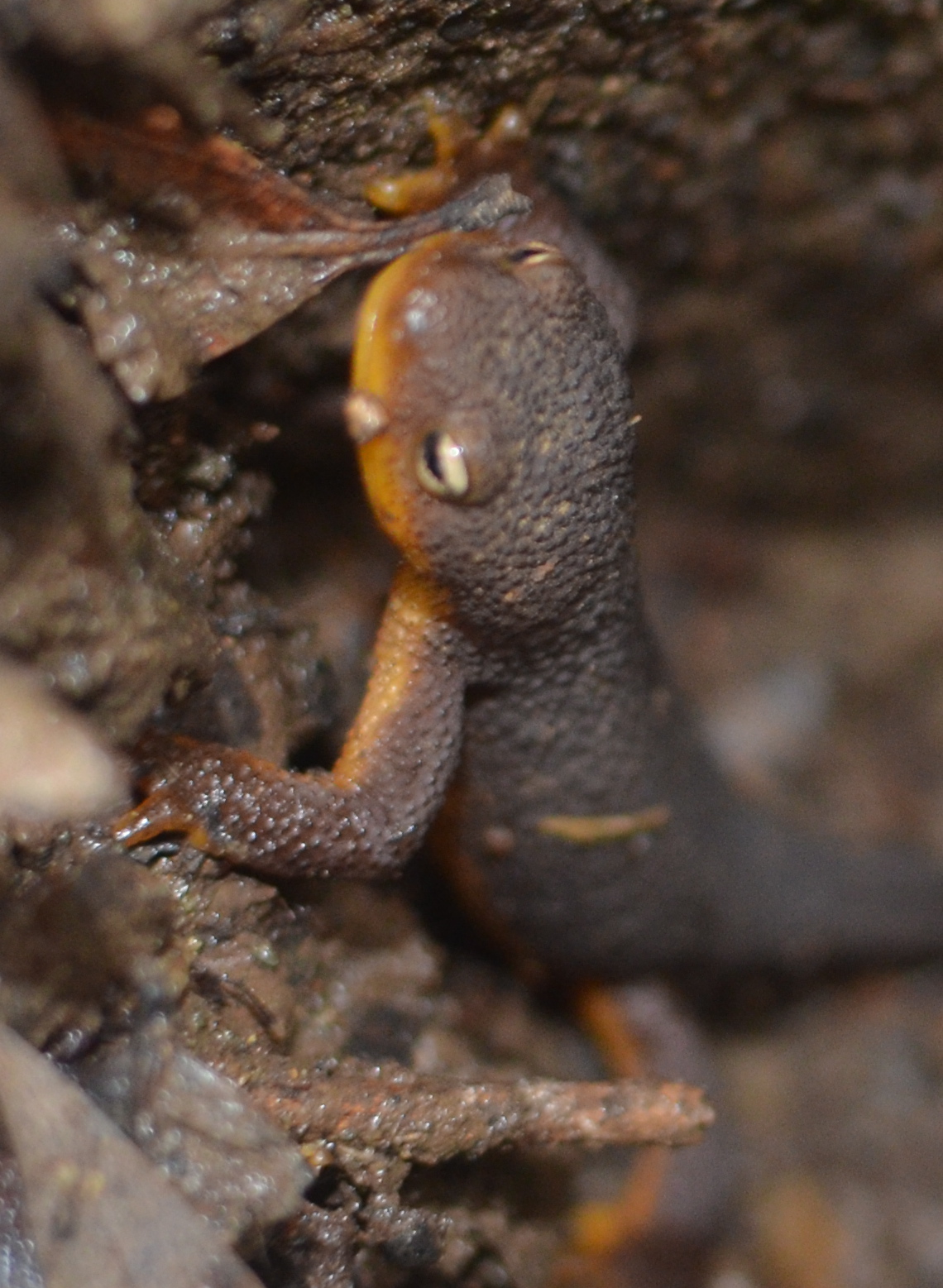
What is cute, small, brown, moves at the pace of a drunk snail, and secretes a particularly potent neurotoxin? 

Rough-Skinned Newt, aka Taricha granulosa


Why did the newt cross the trail?

To breed on the other side...

I've been tempted to make a sign alerting people to keep an eye out for Newt Crossings, which are a regular occurrence these days. Some newts in this particular area have been alerted by celestial cues that it is time to migrate.

Aside from being my chosen trail of choice for training runs, Rancho San Antonio Open Space Preserve is home to both the Rough-Skinned Newt (Taricha granulosa) and the California Newt (Taricha tarosa).

I'm fascinated by these amphibians. They are so clearly in their own world, meandering along, searching for the perfect water spot to get it on. They blend in really well with their habitat, so it's actually quite dangerous if they migrate through a heavily trafficked area. Wildcat Canyon trail, which follows an oak-lined canyon leading up to the west side of Black Mountain in the preserve has heavy traffic. And the other day, I came across a few newts who didn't make it.

What do you think, a big yellow sign that says, Newt Xing?

A few fast facts:

1. Newts are able to regenerate body parts. Yes, cut off a leg, and they will grow a new one. Not only that, you could poke out their eyes, break their spine, rip out their heart, break their jaw in a fight, or if you were really mean, take out their intestines, and it wouldn't phase them. Ok, well, maybe it would phase them if you did that all at once. But they have cells which are able to de-differentiate at an injury site, reproduce, and re-differentiate to grow new limbs which retain structure and function. Pretty cool, eh? So, don't go dissing the newts.

2. Newts, particularly the Rough-Skinned Newt as seen above, secrete neurotoxins called tetrodotoxin and terichatoxin. The former of these is  more poisonous than potassium cyanide. Similar to pufferfish and other animal species who secrete these chemicals. If ingested, the poison binds to sodium channels in nerve cells and leads to paralysis, and if in high enough doses and depending on the victim, death. Humans usually don't have a problem when handling newts, but should be careful to wash after. Probably humans handling newts cause more damage to the newt because they have semi-permeable skin, and we have chemicals and oils that could make their lives rough.

As members of the Salamander family, these particular species have a range from the coastal areas of California, inland to higher foothill elevations and extend up to Alaska. They like cool waters from ponds, lakes, streams, and slow-moving rivers. Terrestrial adults like to hang out in grasslands, woodlands, or coniferous forest beds, under rocks, leaf litter and beneath fallen logs. They eat crustaceans, insects, snails, leeches, worms, or other larvae and are estimated to live for up to 20 years.

Salamanders, like other amphibians, are sensitive bioindicators, providing insight into water quality and watershed health. California newt populations in Southern California are considered by the California Department of Fish and Game to be Species of Special Concern. Populations have declined due to introduction of non-native species, pollution, and human development. 


Next time your out in Newt habitat keep your eyes peeled for these incredible creatures.

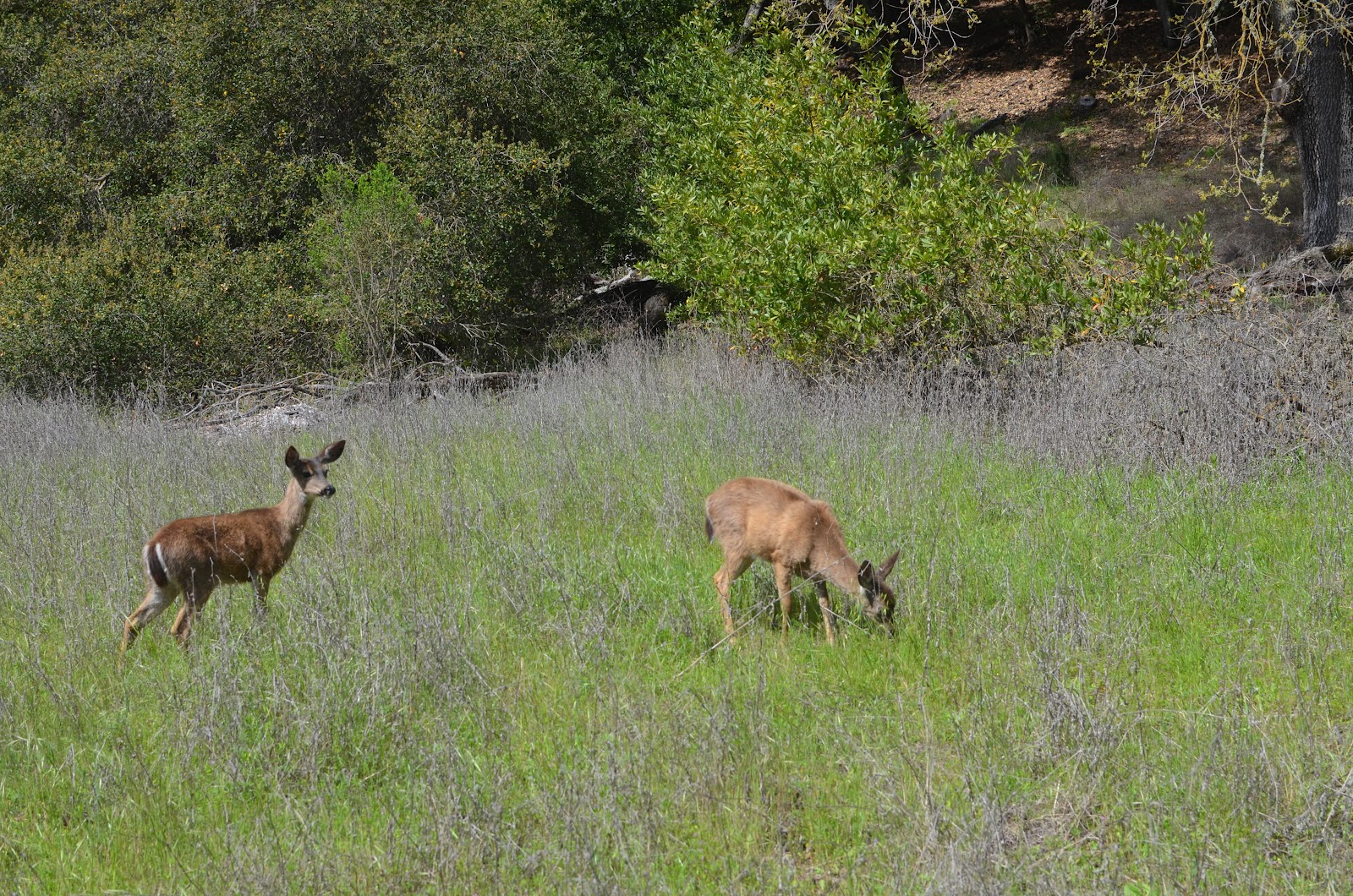
Now that I got that out of my system, just a few more pictures from a hike I took today out on the trail. I  decided to give running a break, and carried a notebook, camera, and moved slowly, like a newt. I saw black-tailed deer, western scrub-jay, california quail, *heard and saw* wild turkey, a bees nest, various species of mushroom, and pretty little wildflowers in bloom.


Black-Tailed Deer

Steen, Sue, can you ID?

Wildcat Canyon Trail

I was told this is a "Jack-O-Lantern" Mushroom by a fellow mushroomer.  Neat fact: it is bioluminescent. 
water droplets in a web

Caught in a web

So pretty, yet so uncomfortable. I love to look at Poison Oak this time of year

Ghost Spider (as dubbed by me)